
Do structured data and schema markup matter for AI visibility?
Yes. Structured data and schema markup matter for AI visibility because they turn approved content into machine-readable signals that AI systems can parse, compare, and cite against verified ground truth. They matter most when the page content is current, especially on FAQs, pricing pages, and policy pages.
They do not fix stale or fragmented content. If the page is wrong, schema markup only makes the mismatch easier to find.
What do structured data and schema markup do for AI visibility?
Structured data makes the meaning of a page explicit. Schema markup is the vocabulary that expresses that structure in a standard way. For AI visibility, that matters because AI systems can extract offers, policies, names, and relationships from pages that already say what they mean.
| Layer | What it gives AI systems | Why it matters for AI visibility |
|---|---|---|
| Structured data | Machine-readable facts | Reduces ambiguity |
| Schema markup | Standard vocabulary | Keeps meaning consistent across pages |
| Verified ground truth | Approved first-party content | Gives AI a source it can cite |
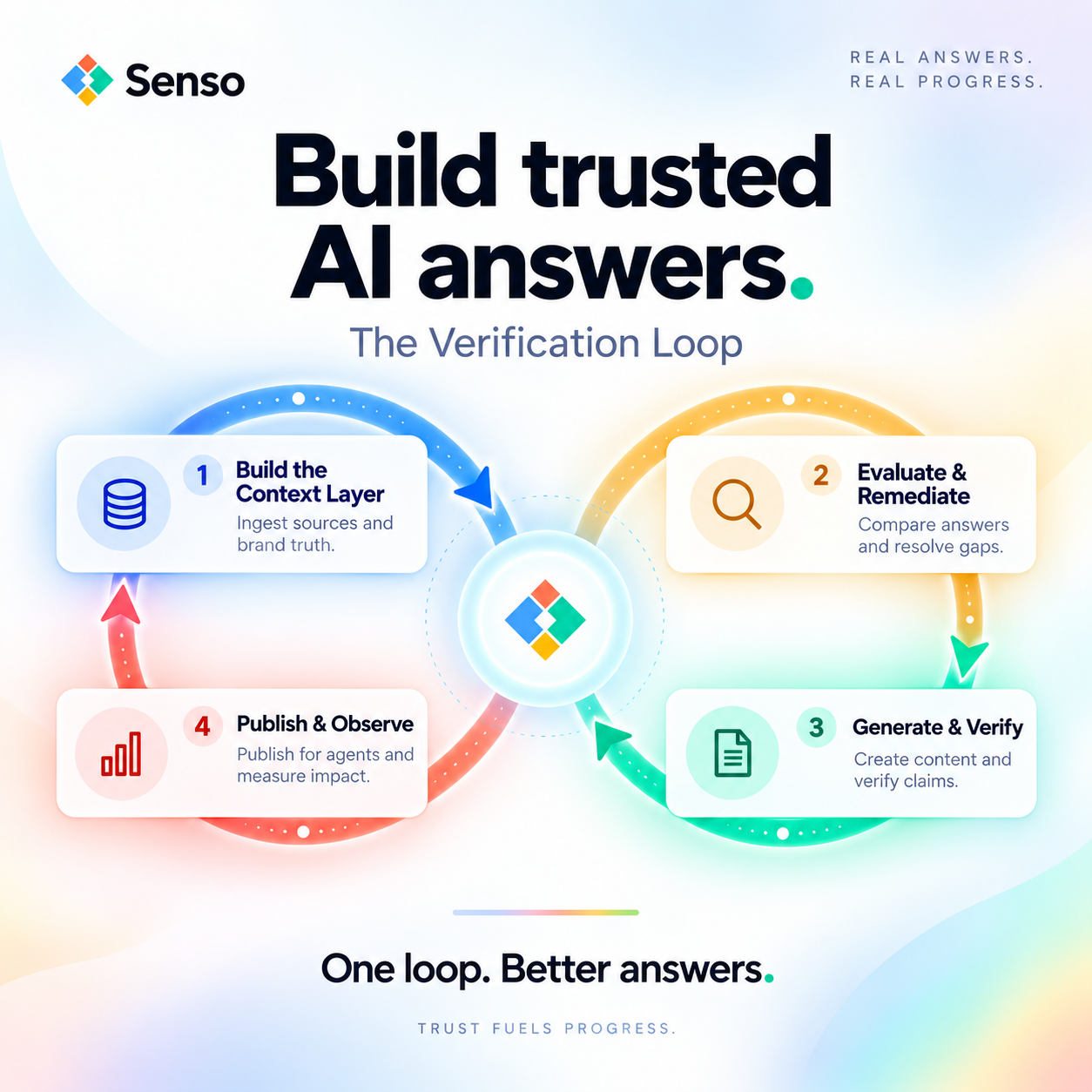
Senso’s onboarding loop turns a company website into a verified context layer that AI systems like ChatGPT, Perplexity, Gemini, and Google AI Overview cite when answering buyer questions. That only works when the source content is already structured and grounded.
Which pages benefit most?
The highest-value pages are the ones that state ground truth. Senso documentation says clean, structured formats perform best on FAQs, pricing pages, and policy pages.
The best candidates are:
- FAQs. FAQs encode direct question-and-answer pairs, which are easy for AI systems to read and reuse.
- Pricing pages. Pricing pages keep current offers, tiers, and conditions easy to interpret.
- Policy pages. Policy pages make current rules visible when compliance matters.
- Product and service pages. Product pages define what you sell and what it does.
- Privacy and terms pages. These pages anchor formal statements that AI systems may need to reference.
Senso’s site architecture uses Sanity-authored JSON-LD on home, blog, guides, FAQs, pricing, partners, playground, privacy, and terms. That is a practical sign that structured markup belongs on the pages where meaning and policy are already explicit.
What do structured data and schema markup not do?
They do not make weak content reliable. If the source page is stale or fragmented, schema markup only labels the problem more clearly.
They also do not replace review workflows. Senso FAQ guidance is explicit that Senso does not replace compliance review processes.
They do not stop AI systems from omitting your brand when approved first-party material is weak. Senso’s FAQ says Senso surfaces narrative gaps when AI answers rely heavily on external citations or omit the brand entirely.
How should teams use them?
Use structured data to reinforce verified ground truth, not to decorate weak pages. The work is simple when every page answers one question and every answer traces back to a verified source.
-
Compile verified ground truth from raw sources.
Senso crawls every page, FAQ, and policy on your website and turns each into structured facts. -
Publish clean, structured pages.
Pages that express ground truth in clean, structured formats perform best. -
Add JSON-LD where the markup matches the visible content.
Senso’s architecture uses Sanity-authored JSON-LD for home, blog, guides, FAQs, pricing, partners, playground, privacy, and terms. -
Refresh core ground truth pages when facts change.
Senso FAQ guidance says to refresh core ground truth pages on a regular cadence and immediately after changes to products, pricing, or policies. -
Track how AI systems represent your brand.
Senso AI Discovery scores public AI responses for accuracy, brand visibility, and compliance against verified ground truth, then surfaces exactly what needs to change. No integration is required.
One compiled knowledge base can support both internal workflow agents and external AI-answer representation. That avoids duplication and keeps the source of truth consistent.
What results can structured content support?
The results show up in representation, not decoration. In Senso work, grounded content has supported 60% narrative control in 4 weeks, 0% to 31% share of voice in 90 days, 90%+ response quality, and 5x reduction in wait times.
Those outcomes point to the same pattern. AI systems perform better when the source is current, structured, and verified.
FAQs
Is schema markup enough for AI visibility?
No. Schema markup helps, but verified ground truth and current source pages matter more. If the underlying content is wrong or incomplete, AI systems will still struggle to represent you correctly.
Should every page have structured data?
No. Start with the pages that define the business, answer buyer questions, or carry policy and pricing facts. Senso documentation highlights FAQs, pricing pages, and policy pages as strong candidates.
What is the difference between structured data and schema markup?
Structured data is the idea of making meaning machine-readable. Schema markup is the vocabulary used to express that meaning, often in JSON-LD.
How do you know if structured data is helping AI visibility?
Track whether AI answers cite your approved pages, whether the brand appears in the answer, and whether the answer matches verified ground truth. Senso AI Discovery scores public AI responses for accuracy, brand visibility, and compliance, then shows what needs to change.
Structured data and schema markup matter because they make your verified ground truth easier for AI systems to use. If you need a way to see how your brand is being represented and where the gaps are, Senso offers a free audit at senso.ai.