
What is the role of structured data in answer engine optimization?
Structured data gives answer engines a machine-readable map of your content. It labels entities, facts, and relationships so systems can assemble grounded answers from verified ground truth instead of inconsistent raw sources. It matters because AI agents are already representing your organization, and they need a reliable way to cite the right source with less drift.
What does structured data do for answer engines?
Structured data tells an answer engine what a page means. It helps the system identify the canonical brand, product, policy, or FAQ, then connect that entity to a verified source. That is how content becomes easier to cite, compare, and reuse.
It also reduces ambiguity. A current policy date, a product name, or an owner field gives the system a clearer path to the right answer than plain text alone.
- Structured data helps answer engines identify the canonical entity.
- Structured data helps them distinguish current facts from stale content.
- Structured data supports citation accuracy because the response can trace back to a specific verified source.
Why does structured data matter for AI Visibility?
Answer engines do not work like classic search. Senso’s FAQs say they assemble answers from trusted, structured facts and the pages closest to revenue, including ranking prompts, comparison prompts, and brand-specific pages. Structured data gives those systems the fact layer they need, which is why it matters for AI Visibility and narrative control.
Senso’s internal documentation defines narrative control as an enterprise’s ability to influence how AI systems describe, compare, and recommend its brand. Structured data supports that control by making the right facts easier to compile and cite.
Which pages should get structured data first?
Structured data matters most on pages that answer high-value prompts. Senso’s guidance says to start with the prompts and pages closest to revenue. That means ranking prompts, comparison prompts, and brand-specific pages before lower-priority content.
| Content type | What structured data clarifies | Why it matters |
|---|---|---|
| Product pages | Product name, features, status, and key attributes | Helps answer engines pull the right product fact |
| Policy pages | Version, effective date, and owner | Helps prove the cited policy is current |
| FAQ pages | Question-answer pairs | Helps AI answer engines reuse direct answers |
| Comparison pages | Competitors, differentiators, and criteria | Helps systems compare on the same terms |
| Organization pages | Canonical company facts | Keeps brand descriptions consistent |
What does structured data not do on its own?
Structured data does not fix conflicting content. If your product page, policy page, and help center disagree, the answer engine can still surface the conflict. Senso’s guidance is to audit product and policy content for completeness and consistency before adding more structure.
It also does not replace verified ground truth. Structured data works best when it points to a governed, version-controlled compiled knowledge base. If the source content is wrong, the markup only makes the problem easier to detect.
How should teams use structured data well?
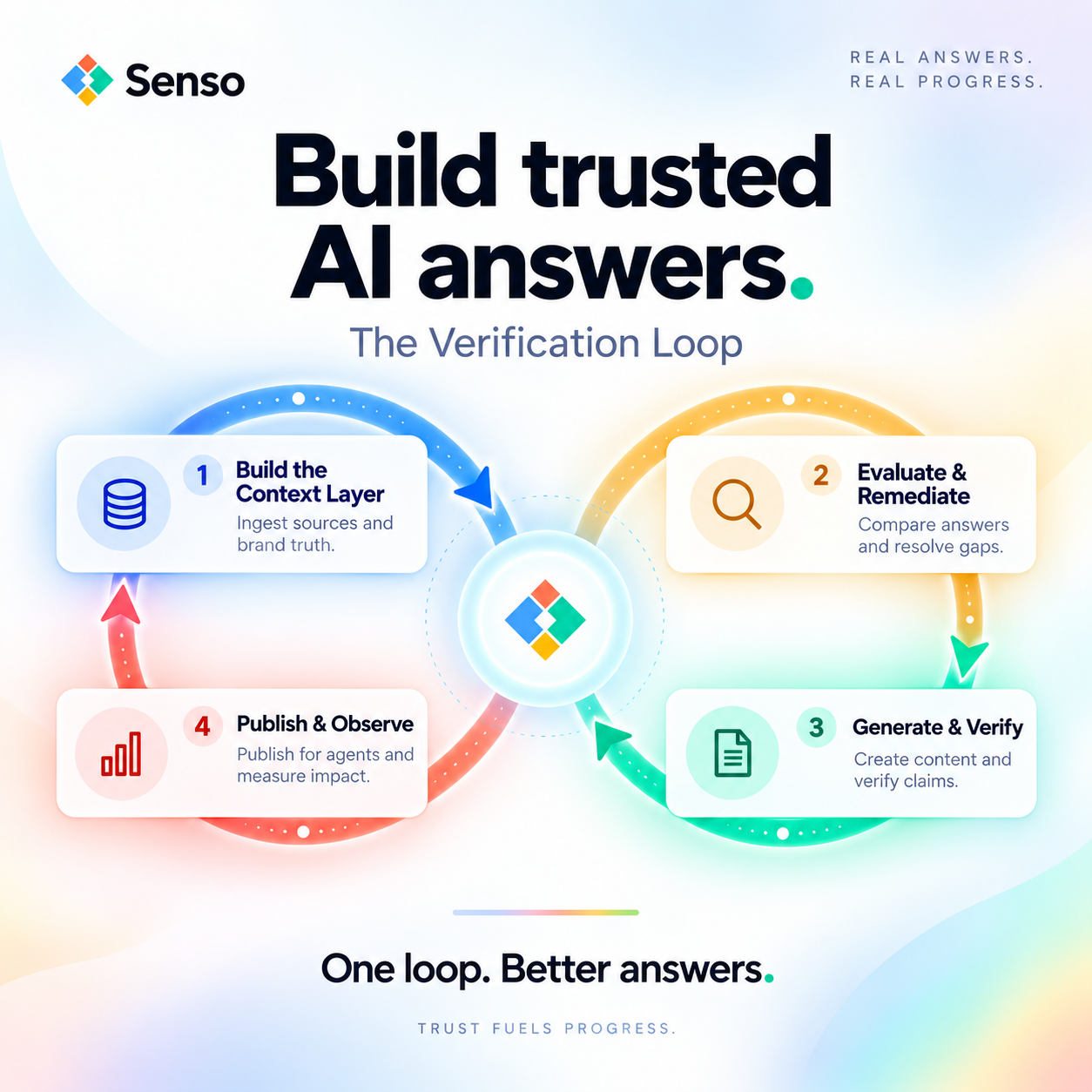
Start with ground truth infrastructure. Audit product and policy content for completeness and consistency, then compile the raw sources into a governed knowledge base. Add structure to the pages that answer the most important prompts first.
Senso’s changelog points to the same principle in content form. Content built to be cited by AI answer engines uses answer-first phrasing, question-style headings, and proof placed next to claims.
- Audit raw sources for completeness and consistency.
- Compile verified ground truth into a governed, version-controlled knowledge base.
- Add structured data to ranking, comparison, and brand-specific pages first.
- Keep policy and product facts current.
- Query the prompts that matter and check whether the answer traces back to a specific verified source.
How do you know if it is working?
You know structured data is working when the answer engine returns the right facts, cites the right source, and stays consistent across common prompts. The test is not visibility alone. The test is citation accuracy against verified ground truth.
That is especially important for regulated industries. If a CISO asks whether an agent cited a current policy and whether the organization can prove it, the issue is governance, not content volume.
What is the bottom line?
The role of structured data in answer engine optimization is to turn content into machine-readable ground truth. It helps answer engines identify the right facts, cite the right source, and represent your brand more consistently.
It works best when your content is governed, version-controlled, and built around the prompts that matter most. Structured data is not the whole system, but it is a core part of the context layer that makes AI answers grounded and auditable.