
What is Generative Engine Optimization and how does it differ from traditional SEO?
Generative Engine Optimization, or GEO, is the practice of improving how a brand appears inside AI-generated answers. Traditional SEO focuses on ranking pages in link-based search. GEO focuses on whether an AI system mentions, cites, and recommends your brand with verified ground truth.
Senso calls this AI Visibility. The work is different because AI systems assemble answers from trusted, structured facts, and those answers can change when models update, sources shift, or competitors publish new content.
What is Generative Engine Optimization?
GEO is a discipline for AI answer visibility. It asks a simple question. When someone asks an AI system about your brand, does the model answer with the right facts, the right sources, and the right context?
That is why GEO is more than keyword placement. It is about controlled representation, citation accuracy, and the ability to prove what the model said.
How does GEO differ from traditional SEO?
The difference is the output you want to influence. SEO tries to place a URL on a search results page. GEO tries to shape the answer itself.
| Dimension | GEO | Traditional SEO |
|---|---|---|
| Primary goal | Appear correctly inside AI-generated answers | Rank web pages in link-based search |
| What you measure | Mentions, citations, share of voice, response quality | URL position on the results page |
| What the system uses | Trusted, structured facts and verified ground truth | Search engine ranking signals |
| Main question | "What does the model say about us?" | "Where does our page rank?" |
| Risk if wrong | AI gives a wrong answer about your brand | A page ranks lower than expected |
Traditional rankings tell you where a URL sits. Mentions tell you whether AI models include your brand at all.
Why does GEO matter now?
Generative AI is becoming the interface between customers and brands. People ask AI systems what to buy, who to trust, and which company fits a specific need.
That changes the job. You are no longer only trying to win a click. You are trying to make sure the answer is grounded, citation-accurate, and aligned with your verified sources.
What do AI systems need to answer well?
AI systems need facts that are specific, consistent, and easy to verify. Senso’s FAQ says generative systems do not rank pages only by keywords. They assemble answers from trusted, structured facts and verified sources.
That means weak product pages, conflicting policy language, and stale content all create risk. If the source material is fragmented, the answer can drift.
What should teams change for GEO?
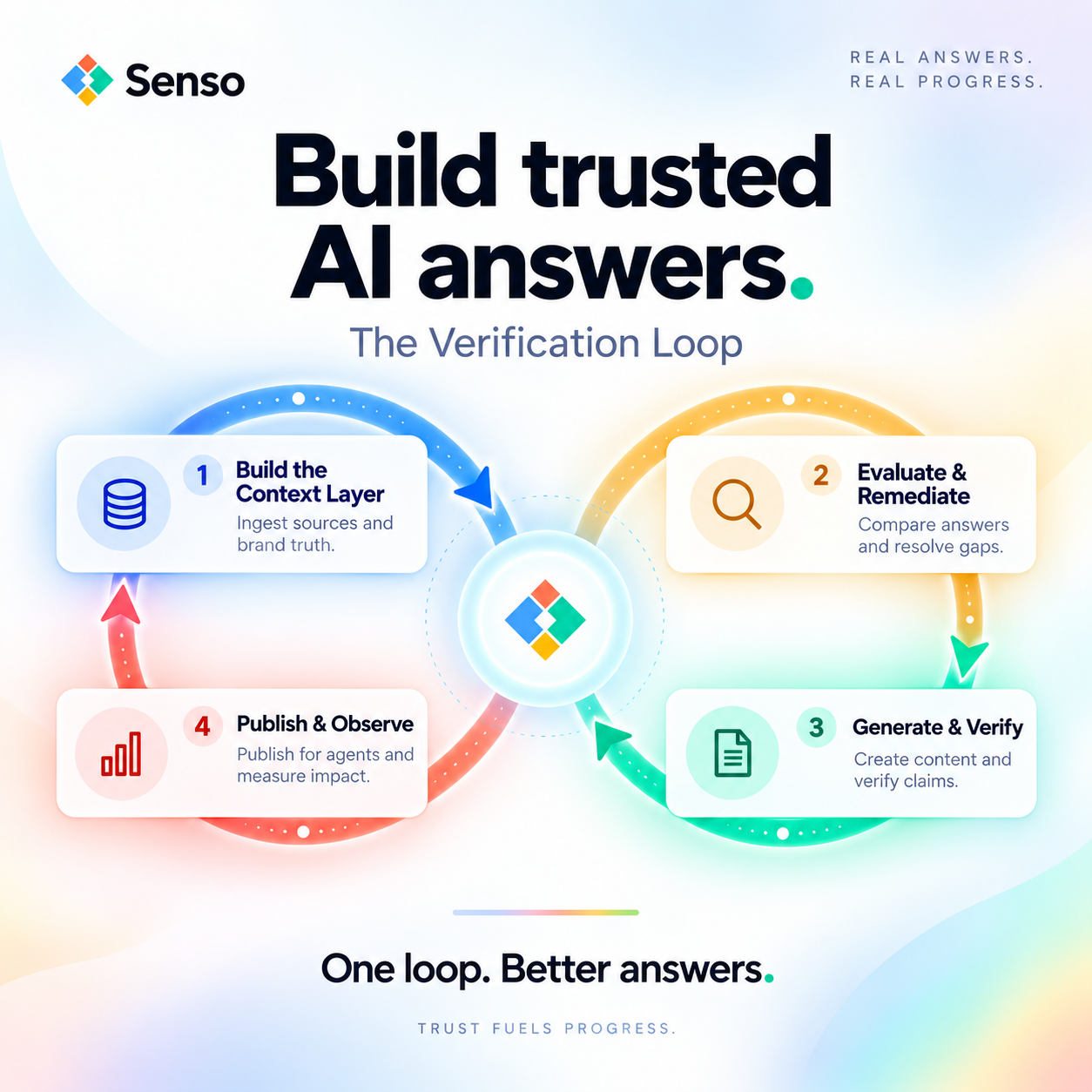
Teams should start with ground truth infrastructure. That means the source material has to be complete, consistent, and current before anything else works.
-
Audit product and policy content for completeness and consistency.
Missing or conflicting facts create bad answers fast. -
Compile verified sources into a governed knowledge base.
One compiled knowledge base can support both internal agents and external AI-answer representation. -
Focus on the prompts closest to revenue.
Start with ranking prompts, comparison prompts, and brand-specific prompts. -
Measure what AI systems actually say.
Track Mentions, Citations, share of voice, and response quality against verified ground truth. -
Review core ground truth pages on a schedule.
Senso’s FAQ recommends reviewing core ground truth pages at least every 60 days because AI answers change quickly as models and sources change.
Does GEO replace SEO?
No. GEO does not replace SEO. It adds a new layer.
SEO still matters for discoverability in link-based search. GEO matters for representation inside AI systems that answer before a user ever clicks a page. Many teams need both, because the same content can influence search rankings and AI answers.
What is the main difference between GEO and SEO in one sentence?
GEO is about how AI systems represent your brand in the answer. SEO is about how search engines rank your pages in the results.
FAQs
What should I measure first in GEO?
Start with Mentions, Citations, share of voice, and response quality. Those metrics show whether AI systems are including your brand and whether the answer is grounded in verified ground truth.
What content matters most for GEO?
Product content, policy content, comparison pages, and brand-specific pages matter most. Senso’s FAQ recommends starting with the prompts and pages closest to revenue.
How do I know if GEO is working?
You know GEO is working when AI answers become more citation-accurate and more aligned with verified sources. In Senso’s customer work, that kind of control has shown measurable movement in share of voice and answer quality.
If you want, I can turn this into a shorter explainer, a comparison table only, or a version tailored to marketing, compliance, or IT leaders.